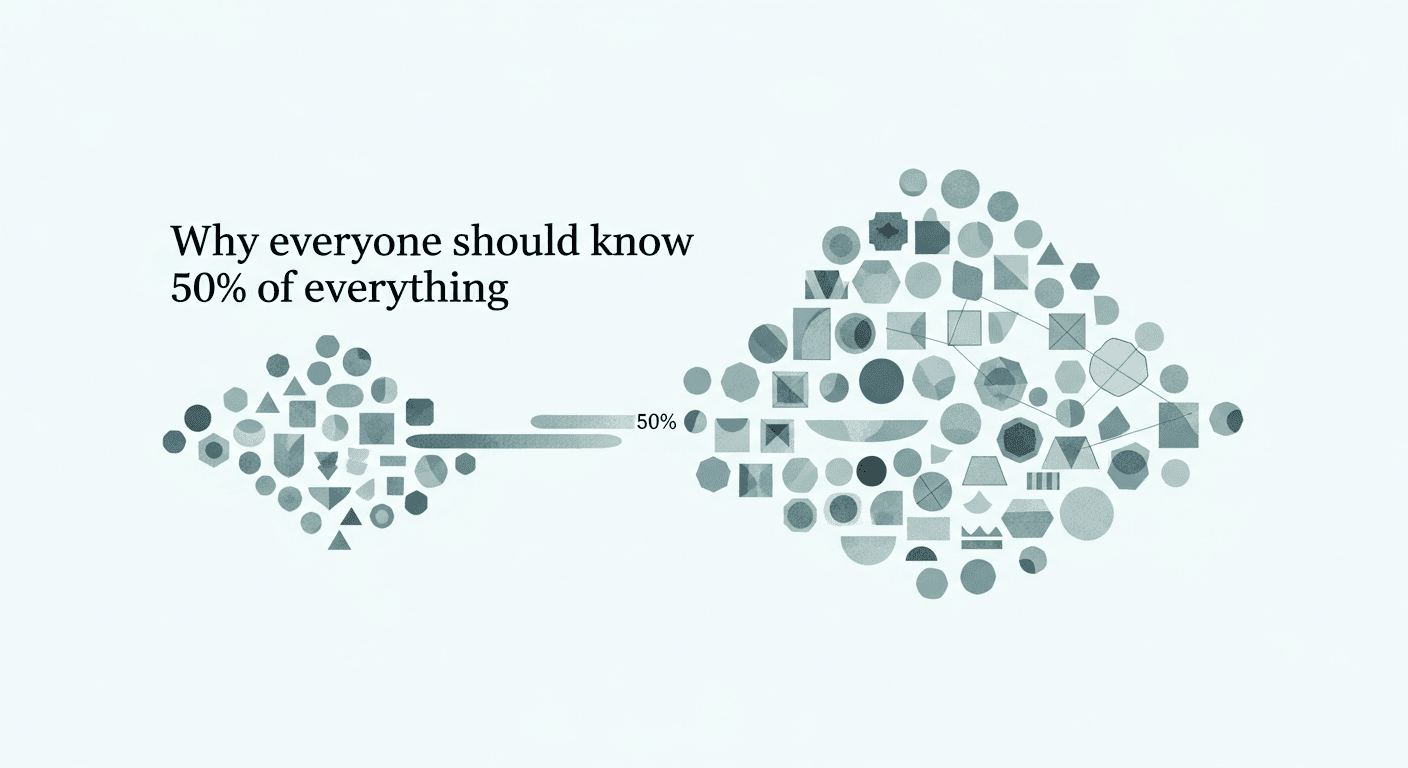
Why everyone should know 50% of everything
The conventional wisdom is clear: specialize. Go deep. Become the expert.
But here's what I've learned after a decade of building products: the most dangerous people on a team are the ones who only know their domain.
The backend engineer who doesn't understand P&L will optimize for elegance over revenue. The product manager who can't read a database schema will write requirements that are technically absurd. The CEO who avoids technical detail will let complexity pile up unchecked, never questioning why pruning doesn't happen.
I call it the 50% rule: know enough about adjacent domains to communicate across functions and understand trade-offs—while acknowledging the specialists know more in their domain.
50% knowledge is powerful precisely because it's incomplete. You know enough to ask the right questions. You know enough to smell when something is off. But you don't know enough to be certain—which keeps you curious and open to being corrected.
This is the difference between systems thinkers and silo-thinkers. Silo-thinkers optimize locally. They make their piece perfect while the whole system fails. Systems thinkers see connections. They understand that the "best" solution in isolation is often the wrong solution in context.
The uncomfortable truth is that 50% knowledge requires more work, not less. It means sitting in engineering reviews when you're a business person. It means reading quarterly reports when you're an engineer. It means caring about domains that aren't "your job."
Most people won't do this. They hide behind specialization as an excuse to stay comfortable.
But the leaders I respect most are the ones who can hold a meaningful conversation with anyone on their team—not because they're the expert, but because they've done the work to understand the landscape.
Knowing 50% of everything isn't about being a generalist. It's about being a complete thinker.